
Photo Scanners for Home Use and Archiving
As an Amazon Associate, I earn from qualifying purchases. Some links may earn us a commission at no extra cost to you.
Photo-scanning needs vary widely. Large boxes of loose prints benefit from automatic feeding, while 35mm negatives and slides call for dedicated film hardware. Oversized or fragile originals are better suited to flatbed scanning, and some users may prefer a standalone converter that does not require a complicated desktop workflow.
The seven options below cover high-volume print scanning, detailed 35mm work, automated film batches, mixed photo-and-film conversion, compact desktop scanning, standalone film conversion, and oversized originals.
Top 7 Picks
1. Epson FastFoto FF-680W — High-Speed Batch Photo Scanning
The Epson FastFoto FF-680W is designed for households working through large collections of loose prints. Its automatic feeder can process compatible photographs in batches rather than requiring each image to be positioned individually.
It can also capture the front and back of a photo in one pass, which is useful when dates, names, or notes are written on the reverse.
Why consider it: Its automatic feeding and duplex capture are suited to digitizing large quantities of standard photo prints efficiently.
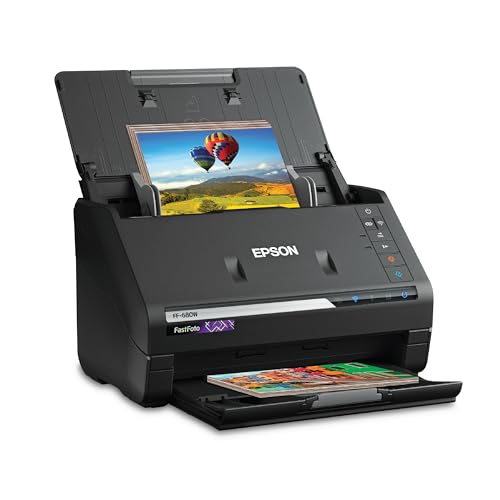
- HIGH-SPEED PERSONAL PHOTO SCANNER¹ — Scan thousands of photos as quickly as 1 photo per second at...
- PRESERVE YOUR PRICELESS PHOTOS — Photo scanner for transforming old pictures to digital fast...
- SHARE STORES FOR FUTURE GENERATIONS — After scanning your photos with this Epson FastFoto scanner...

Pros
- Automatic feeding for photo batches
- Captures front and back in one pass
- Wireless and USB connectivity
- Photo organization and restoration software
Cons
- Not designed for negatives or mounted slides
- Fragile or badly curled photos may require another scanning method
Trade-offs / Who should skip: Choose a flatbed-style scanner for delicate originals or a dedicated film scanner when negatives and slides make up most of the archive.
2. Plustek OpticFilm 8200i SE — Detailed 35mm Film Scanning
The Plustek OpticFilm 8200i SE is a dedicated scanner for 35mm negatives and mounted slides. Its listed optical resolution reaches 7200 x 7200 dpi, and its infrared channel is designed to help compatible software detect dust and scratches.
The included SilverFast software provides additional controls for color, exposure, and film scanning.
Why consider it: It focuses specifically on extracting detail from 35mm film rather than trying to handle prints and documents as well.

- Built-in infrared channel can detect dust and scratches on the surface of the original negatives and...
- 7200 x 7200 dpi (69 Megapixels) for 35mm Negative film and mounted slides. 48-bit input, 24/48-bit...
- Up to 3.6 Dynamic Range Enhanced Multi-Exposure Function for improved image quality 64-bit hardware...
Pros
- Dedicated 35mm film and slide scanning
- Listed 7200 x 7200 dpi resolution
- Infrared channel for dust and scratch detection
- SilverFast software included
Cons
- Film frames require manual handling
- More involved workflow than standalone converters
Trade-offs / Who should skip: A simpler LCD-based converter may make more sense if convenience matters more than detailed software control.
3. Plustek OpticFilm 135i — Automated 35mm Batch Scanning
The Plustek OpticFilm 135i combines dedicated film scanning with automatic holder transport. It can move through multiple compatible negatives or mounted slides without requiring the user to advance every individual frame manually.
That makes it useful for users who have more 35mm material to process but still want a dedicated film-scanning workflow.
Why consider it: Automated holder movement reduces some of the repetitive handling involved in scanning several film frames.

- 【3rd Generation Lens】The newly designed 5-element lens effectively reduces light refraction...
- 【Infrared enhancer】 5-Glass elements lens effectively minimizes IR image plane defocus issues...
- 【Supports Multiple 35mm Film Types】Not only regular 35mm photo image size but also specific...
Pros
- Automatic film-holder transport
- Supports multiple 35mm frames
- Dedicated negative and slide scanning
- Higher-resolution modes available
Cons
- Primarily focused on 35mm formats
- High-resolution batches can take longer to process
Trade-offs / Who should skip: The 8200i SE may suit users who prefer a more hands-on single-frame workflow, while a standalone converter is simpler for casual digitization.
4. ClearClick QuickConvert 2.0 — Mixed Photo-and-Film Conversion
The ClearClick QuickConvert 2.0 handles both 4-by-6 photo prints and several consumer film formats. The supplied listing specifies support for 35mm, 110, and 126 film along with 22-megapixel conversion.
It is also designed to operate without requiring a computer, giving it a different workflow from USB scanners that depend on desktop software.
Why consider it: It combines print and film conversion in one device for users with mixed family-photo collections.
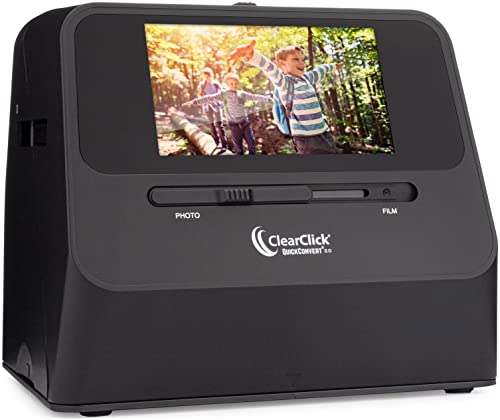
- Easily & Quickly Scan Your Old Photos, Slides, & Negatives To Digital Photos (1 At A Time; Scanner...
- No Computer or Drivers Required! Just Turn It On & Start Scanning. Scans At 14 MegaPixels...
- Built-In Rechargeable Battery For Cord-Free Scanning (Please Fully Charge Before Using) & 5" Instant...
Pros
- Scans 4-by-6 photo prints
- Supports 35mm film
- Supports 110 and 126 film
- 22MP listed conversion
- Does not require a computer
Cons
- Photo-print support is more limited than a conventional flatbed
- Less suited to oversized or fragile originals
Trade-offs / Who should skip: Choose the OpticPro A320E for large or delicate originals, or a dedicated OpticFilm model when 35mm image control is the priority.
5. ScanSnap iX1300 — Compact Photo-and-Document Feeder
The ScanSnap iX1300 is a compact desktop scanner designed for photos, receipts, and documents. It supports both wireless and USB connections and includes automatic and manual feeding options.
Its double-sided color scanning and compact footprint make it useful for households that want one scanner for everyday paperwork as well as compatible loose photos.
Why consider it: It combines photo handling with general household document scanning in a compact desktop format.

- FITS SMALL SPACES AND STAYS OUT OF THE WAY. Innovative space-saving design to free up desk space...
- SCAN DOCUMENTS, PHOTOS, CARDS, AND MORE. Handles most document types, including thick items and...
- GREAT IMAGES EVERY TIME, NO EXPERIENCE REQUIRED. A single touch starts fast, up to 30ppm duplex...
Pros
- Supports photos and receipts
- Automatic document feeder
- Manual feeder
- Wireless or USB connection
- Works with Mac and PC
Cons
- More document-oriented than a dedicated photo scanner
- Not intended for negatives or mounted slides
Trade-offs / Who should skip: Choose the FastFoto if the main task is processing a very large photo-print collection, or a film scanner for negatives and slides.
6. ClearClick Virtuoso 2.0 — Film Converter With 5-Inch Screen
The ClearClick Virtuoso 2.0 is a dedicated film and slide converter with a built-in 5-inch LCD screen. Its supplied listing specifies 22MP conversion and support for 35mm, 110, and 126 negatives and slides.
The large display makes it easier to preview material directly on the scanner than systems built around desktop software.
Why consider it: The built-in screen and multi-format film support suit users who want a simpler approach to digitizing family negatives and slides.
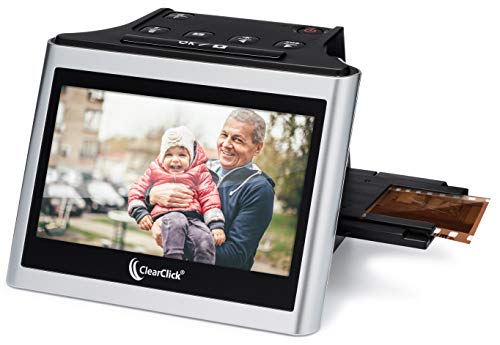
- Quickly & Easily Scan Your Old Film, Slides, & Negatives to Digital Photos at 22 MegaPixels...
- Extra Large 5" Preview Screen - See Your Photos in "Real Time" As You Scan
- Works with 35mm, 110, & 126 Negatives and 50mm Slides - No Computer or Drivers Required
Pros
- 5-inch LCD screen
- 22MP listed conversion
- Supports 35mm film
- Supports 110 and 126 formats
- Dedicated slide and negative workflow
Cons
- Does not replace a scanner for printed photographs
- Offers less software-driven control than the Plustek film scanners
Trade-offs / Who should skip: Choose the OpticFilm models when detailed 35mm scanning controls matter more than a straightforward screen-based workflow.
7. Plustek OpticPro A320E — Large-Format Flatbed Scanning
The Plustek OpticPro A320E provides a 12-by-17-inch scanning surface for large photographs, scrapbook pages, artwork, certificates, books, and other originals that exceed a standard letter-size bed.
Its flatbed format also keeps the original stationary during scanning, which can be useful for materials that should not pass through feeder rollers.
Why consider it: The large scanning bed accommodates oversized and irregular originals that smaller scanners cannot handle in one pass.
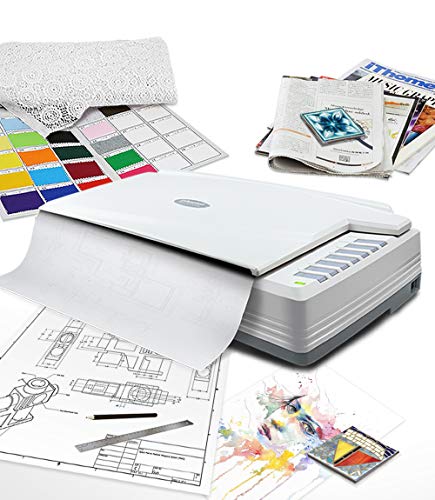
- [PROFESSIONAL LARGE-FORMAT SCANNING] - up to 12"x17" scan area , allows you to quickly and easily...
- [EASY FILE MANAGEMENT] - With Doc Action, you easily scan and save to different file format. It also...
- [BATCH SCANNING] With A320E, you can scan multiple printed images at one time and save to a Multiple...
Pros
- 12-by-17-inch scanning area
- Flatbed design
- Suitable for oversized photographs and artwork
- Useful for albums and scrapbook material
Cons
- Requires substantial desk space
- Excessive for users scanning only ordinary 4-by-6 prints
Trade-offs / Who should skip: A compact feeder or batch photo scanner is more practical when the archive consists mostly of standard loose prints in good condition.
Quick Compare
- High-volume loose photo scanning: Epson FastFoto FF-680W
- Detailed manual 35mm scanning: Plustek OpticFilm 8200i SE
- Automated 35mm batch scanning: Plustek OpticFilm 135i
- Mixed 4×6 photo and film conversion: ClearClick QuickConvert 2.0
- Compact photo and document scanning: ScanSnap iX1300
- Screen-based film conversion: ClearClick Virtuoso 2.0
- Oversized and fragile originals: Plustek OpticPro A320E
Final Verdict
These seven scanners cover different types of home archives. The Epson FastFoto emphasizes batch processing of loose photo prints, while the Plustek OpticFilm 8200i SE and 135i focus on 35mm negatives and slides with different levels of automation.
The ClearClick QuickConvert 2.0 adds mixed print-and-film capability, while the ScanSnap iX1300 combines photo handling with everyday document scanning. The ClearClick Virtuoso 2.0 provides a screen-based film workflow, and the Plustek OpticPro A320E handles oversized or fragile originals that are better kept on a flatbed.
The appropriate format depends mainly on whether the collection contains loose prints, film, mixed media, documents, or large originals—and whether scanning speed, software control, or simplicity matters most.
As an Amazon Associate, I earn from qualifying purchases.