
Best Essential Bass Pedals for Any Board
As an Amazon Associate, I earn from qualifying purchases. Some links may earn us a commission at no extra cost to you.
A tight bass rig usually comes down to five “foundation” pedals: tuning, dynamics control, core drive, pitch thickening, and a reliable preamp/DI. I picked pedals that are widely compatible, easy to power, and proven staples for real-world gig and recording setups.
Top picks
BOSS TU-3 — Best for always-in-tune gigs (and powering a small board)
If I could only start with one pedal, it’s a dependable tuner. The TU-3 is the kind of “boring essential” that keeps everything else working smoothly.
Why it wins: fast, stage-friendly tuning + reliable build.

- Industry-Leading Stage Tuner: Tune your guitar or bass on stage with the TU-3, successor of the BOSS TU-2, the world's top-selling stage tuner
- Durable Construction with High-Visibility Display: Housed in a tank-tough BOSS stompbox body, the TU-3 features a smooth 21-segment LED meter with a High-Brightness mode that cuts through the harshest outdoor glare
- Adjustable LED Meter: 21-segment LED meter with brightness control for optimal visibility in any lighting condition
Pros
- Quick, readable tuning for bass on dark stages
- Mutes your signal for silent tuning
- Common pedalboard footprint and power requirements
- Built like a tank for frequent stomping
Cons
- Not a “tiny” tuner footprint
- Some players prefer strobe-style tuning feel
Trade-offs / Who should skip: If you only play at home and tune off a clip-on, you can skip this—but live or recording, I wouldn’t.
Scores: Performance 5/5 • Low-end retention 5/5 • Ease of Use 5/5 • Value 4/5
MXR M87 Bass Compressor — Best for consistent notes and controlled dynamics
Compression is what makes your bass sit “finished” in a mix—especially with slap, pick, or modern worship/rock tones.
Why it wins: clear control + bass-friendly behavior when set right.

- CHT Constant Headroom Technology for clear, clean performance
- True bypass
- 10 gain-reduction status LEDs

Pros
- Great for evening out the volume between strings
- Helps notes sustain without cranking amp gain
- Flexible controls for subtle-to-firm compression
- Works well before drives to keep them predictable
Cons
- Can feel complex if you’ve never used a compressor
- Heavy compression can dull the attack if overdone
Trade-offs / Who should skip: If you hate “processed” feel, keep it subtle—or skip and rely on amp compression.
Scores: Performance 5/5 • Low-end retention 4/5 • Ease of Use 4/5 • Value 4/5
Trace Elliot Transit B Bass Preamp & DI — Best for a “finished” bass tone direct
This is the anchor for going straight to a PA/interface while still sounding like a real bass amp is involved. The Transit B pairs a full bass preamp with a balanced XLR DI, three-band EQ, and onboard drive.
Why it wins: dependable DI + amp-style tone-shaping in one gig-proof box.

- Color coordinated backlit controls
- Passive/Active switch
- Pre-shape switch for the classic Trace Elliot EQ curve
Pros
- Balanced XLR DI for silent stages and direct recording
- Three-band EQ plus onboard drive for a finished tone
- Trace Elliot’s classic bass voicing baked in
- Great “backup rig” even if your amp dies
Cons
- Premium price versus a basic DI
- More of a full preamp than a simple DI box (more to dial in)
Trade-offs / Who should skip: If your amp already has a DI you love and you never go direct, this can be optional—but it’s a lifesaver pedal for direct rigs.
Scores: Performance 5/5 • Low-end retention 4/5 • Ease of Use 4/5 • Value 3.5/5
Electro-Harmonix Bass Big Muff Pi — Best for classic fuzz that still keeps lows
A bass fuzz that doesn’t erase your low end is the difference between “huge” and “gone.” This one is a standard pick for a reason.
Why it wins: thick fuzz tone with bass-friendly controls.

- Tailor your drive/distortion sound with sustain, tone and volume knobs
- A dry switch that mixes your dry bass with the Bass Big Muff Pi's distortion
- A bass boost EQ switch that reintroduces your low frequencies when tone is set for high frequencies
Pros
- Big, sustaining fuzz that works for rock/alt/stoner
- Can keep clarity better than many guitar fuzzes on the bass
- Easy to dial in a usable sound fast
- Iconic “wall of sound” character
Cons
- Fuzz can get fizzy if you push treble-heavy settings
- Not the most “modern tight” distortion style
Trade-offs / Who should skip: If you only need mild grit, you may prefer a lighter overdrive instead of full fuzz.
Scores: Performance 4/5 • Low-end retention 4/5 • Ease of Use 5/5 • Value 5/5
TC Electronic SUB ‘N’ UP Octaver — Best for thicker lines and synth-ish layering
An octave pedal is my favorite “instant bigger” effect—it tightens riffs, fattens choruses, and can fake synth-bass vibes.
Why it wins: flexible octave sounds with strong tracking for common bass lines.
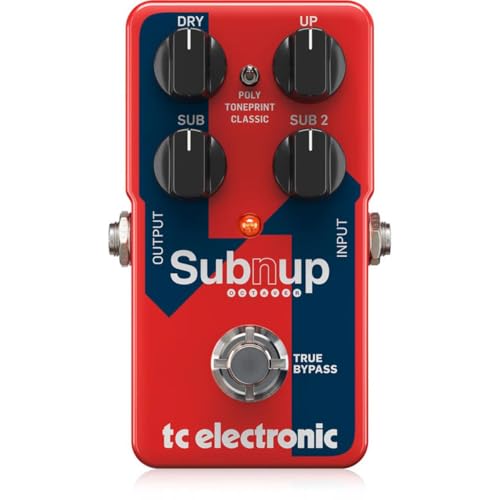
- Octaver Pedal with Controls f Dry
- TonePrint Capabilities
- 3-way Mode Switch
Pros
- Adds weight without changing your playing style
- Great for trios/one-guitar bands (fills space)
- Can do subtle thickening or obvious octave effects
- Useful for modern pop/EDM-inspired bass parts
Cons
- Fast runs can reveal tracking limits (any octaver can)
- Deep settings can get muddy if your amp is already boomy
Trade-offs / Who should skip: If you never use effects and only want “pure bass,” skip it. If you want one fun pedal that’s still practical, this is it.
Scores: Performance 4/5 • Low-end retention 4/5 • Ease of Use 4/5 • Value 4/5
Quick compare (no table)
- Just starting: TU-3 + M87 (clean fundamentals first)
- Direct-to-PA/recording focus: Trace Elliot Transit B (anchor tone) + TU-3
- Rock board: TU-3 + M87 + Bass Big Muff + Trace Elliot Transit B
- Modern thickening: TU-3 + M87 + SUB ‘N’ UP + Trace Elliot Transit B
Buying guide (how to pick “essential” pedals fast)
My #1 metric: low-end retention
On bass, an effect is only “essential” if it keeps the fundamental (or lets you blend it back in). If your lows vanish, the pedal is a special effect—not a foundation.
A simple signal order that works for most players
- Tuner
- Compressor
- Octave
- Drive/Fuzz
- Preamp/DI
If your drive gets too squashed, swap compressor after drive for a tighter, more “produced” feel.
Power and fit (avoid headaches)
- Most of these expect a standard 9V pedal supply (check your exact unit before plugging anything in).
- Leave space for patch cables; “essential” pedals aren’t essential if your board becomes unreliable.
Two common failure cases (who should skip what)
- If your band is already bass-heavy and boomy: octave and big fuzz can turn to mud fast—use lightly or skip.
- If you play super dynamic music and love touch sensitivity: heavy compression can feel “flattened”—go subtle.
FAQs
What are the true “must-have” bass pedals?
If I’m being strict: tuner + compressor + a solid DI/preamp. Everything else depends on your style.
Do I need a compressor for bass?
Not required, but it’s the quickest path to consistent volume and a mix-ready feel—especially live.
Fuzz vs overdrive for bass: which is more essential?
Overdrive is more “always-on friendly,” fuzz is more dramatic. I included fuzz here because it’s a classic bass sound—if you want subtle grit instead, swap the fuzz slot for a bass overdrive.
Is an octave pedal practical or just for effects?
It’s practical if you use it as a low-mix thickener—great for filling space without adding another instrument.
As an Amazon Associate, I earn from qualifying purchases.